
Gartner BI Magic Quadrant 2026: Same As It Ever Was?
Gartner redefines BI but the dots barely move. Are we in 2014 all over again?

Gartner’s much anticipated Business Intelligence Magic Quadrant 2026 finally dropped, and the biggest surprise is how unsurprising this edition is on its surface. Based on the all-important scatterplot, the dots haven’t really changed much. But does that tell the whole story?
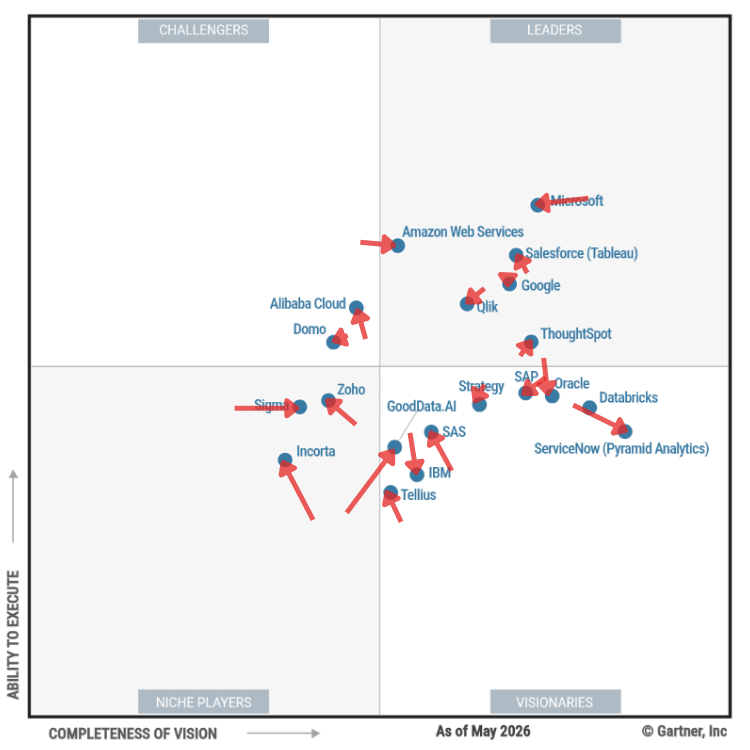
Some notable movements, sure. GoodData.AI moves into the Visionaries Quadrant1, Amazon moves into the Leaders Quadrant, Oracle falls out. Databricks enters in a surprisingly good position and Sisense leaves the report entirely. But not the major shakeup many including myself expected now that AI capabilities have really taken hold of the industry.
Here’s what the dots hide: Gartner quietly reprioritized the feature set to recognize the fundamental change in how users consume BI. If you read the actual text, including the intro, market definition, required features and inclusion criteria, it’s clear that the classic mode of BI production and consumption via click-and-drag builders and static or analytical dashboards is being rapidly replaced by ‘AI-powered conversational experiences.’ Every vendor evaluation now bends towards chat-based, LLM authored BI with a big helping of ‘agents’ mixed in. Yet the dots haven’t changed. What gives?
This article is sponsored by MotherDuck, an all-in-one warehouse, pipeline, and BI platform that’s agent-first, easy to use, and crazy fast. I use it every day and I’m proud to have them supporting Super Data Blog.
You’re Probably Reading the BI MQ Wrong
And it’s okay. I used to read it wrong too before I oversaw three Gartner MQ cycles as VP of Product Strategy at GoodData. The dots are not just a software evaluation; they are an all-encompassing view of the qualifying vendors; features, momentum, marketing, sales experience, enterprise wins, and the quality of the analyst relations team. I spent vastly more time talking to Gartner about our vision and business than I did demoing software features.
Frankly, practitioners don’t care about most of this stuff - a quality marketing team seems irrelevant to success as an analytics builder. That’s true but too narrow a view of what enterprise executives who comprise the real BI MQ audience care about. Enterprises don’t buy software, they get married to it. Their analytics are very complex and time-consuming, and the total package that a vendor offers matters more than just the quality of the software. Incredible features with a garbage sales process, poor support, woeful documentation and no visible market presence works for startups and extremely tech forward enterprise buyers, but for everyone else it’s poison.
ServiceNow’s Pyramid Analytics is this year’s prime example. They are the top vendor in ‘completeness of vision’ and the three positives Gartner shares boil down to good software, good software, good software. The three negatives summarize as acquisition concerns, market concerns, market concerns. They aren’t close to the Leaders Quadrant. From a purchasing executive’s perspective the ServiceNow acquisition and Pyramid’s lack of market momentum are real red flags, even if builders dismiss them.
All this is to say, the BI Magic Quadrant primarily reflects market reality as it exists today. It is a lagging indicator of change, not a leading one. Gartner has begun to redefine their view of the market around AI, but until that redefinition filters through to the buying decisions of enterprises we aren’t going to see a radical shakeup of the dots. This has happened before, and we can learn a lot from it.
2016: The Last Big BI Shakeup
The 2016 BI Magic Quadrant will always stand out in my mind, because it kicked off a slow motion disaster in my professional life. You see I was a partner at PMsquare2, the premier IBM Cognos consulting firm in North America. Cognos had been in the Leaders Quadrant for over a decade and business was good. We had one of the best dots.
But something was quietly brewing in the world and in the text of Gartner’s report that I didn’t catch at the time. The definition of the market was changing primarily in response to Tableau’s explosive growth. Tableau offered high-fidelity dashboards built by analysts seated in the business rather than IT authored reports. It was eating the previous generation of BI alive, and while we certainly felt the pressure in our customer base, our biggest and most profitable clients seemed immune. Until the 2016 Magic Quadrant dropped and suddenly Tableau was the market leader, with IBM trailing distantly behind.
Imagine a game of football where the position of the players AND the location and dimensions of the field change at the same time. That’s the Magic Quadrant. The substrate the dots live in is not fixed - it moves from year to year as the definition of BI changes with new technologies and markets. Tableau did not out-feature IBM in a single year. The shift in momentum actually occurred years earlier. Gartner spent that time adjusting the dots; 2016 was the year they changed the field of play.
The 2016 MQ was the permission slip enterprise clients needed to call up Tableau and get a quote. I watched it happen in real time. And I keep waiting for it to happen again.
Will The Past Repeat Again?
Prior to 2016, the market was defined by major platform players and super vendors. SAP acquired Business Objects, IBM acquired Cognos, Oracle acquired Hyperion. Then a wave of smaller, more innovative firms swept in: Tableau, Qlik, Looker. The little guys led a revolution and overthrew the old guard.
The market today looks similar. All the leaders are mega vendors except one - ThoughtSpot. In Gartner’s view of the current market landscape, BI is a feature, not a company. ThoughtSpot is the exception that proves the rule - they are platform agnostic, query everyone and increasingly consume everyone’s context and semantics. The other players are trying to lock you into their catalog and compute using BI as the cherry on top of an end-to-end data sundae. This explains ServiceNow’s acquisition of Pyramid. I expect there will be more as the direction of travel is towards consolidation across the stack.
It’s easy to say history will repeat. The moment of peak market consolidation is the moment of maximum opportunity for the little guy. Mega vendors have a reputation for poor customer service, painful contract negotiation and stale feature sets. That was true in the past - is it still true today?
I’m not sure. Databricks entered this Magic Quadrant in the best starting position in MQ history as far as I can tell. They are moving extremely quickly - the Databricks AI/BI release notes are the Lord of the Rings of release notes; epic. AI has two effects on BI software - it makes building it much easier, limiting the advantage of smaller, more nimble teams. And it attaches real costs to software usage in the form of tokens. Can a small company afford to subsidize token costs the way Databricks can? I am skeptical.
On the other hand, the things happening at the startup level of BI are genuinely exciting. MotherDuck, Zenlytic, Ridge AI, Golden Analytics, Hex, Evidence, Omni, Count and others are finding new ways to combine BI and AI that the mega vendors haven’t even begun to consider. All of these vendors have a different take on the future of BI that I find compelling.
It’s not easy to say which way this is headed. But I’ll try.
Where the Market is Probably Heading Maybe
In the long run anything is possible. People overestimate short term change and underestimate long-term change. BI tools will still exist in five years; they may not in twenty as agents make all the decisions for us. I genuinely don’t know.
But in the short term, I think we are underestimating the human element of analytics. For example, every vendor now has a sci-fi talk track about agents automatically analyzing data, making recommendations, and taking action. It’s extremely compelling.
Except this feature set has already existed for at least a decade. Sisu Data, BeyondCore, IBM Watson Analytics, ClearStory Data and others all offered some form of this using traditional data science and ML in the pre-LLM days. LLMs certainly offer more compelling natural language descriptions for uncovered insights, but they share the same underlying issues that killed all these products; automatic insights are annoying. First, they create a feed of data you quickly tune out. Second, they often uncover uninteresting insights that business users already knew. Business people put zero premium on data confirmation, and these vendors all sold on the promise of business changing aha moments that never materialized.
The vendors that win are those that design compelling experiences that deliver real results for human beings. There are two sides to this coin. They must contribute to business goals in obvious ways, and they must feel good to use by analytics builders and consumers. You cannot count on an annoying chart notification service or business automation hallucination factory to win this category.
Make something where people say, ‘Software X helped us achieve our goals and felt great for our team to use’ and the prize is yours. Whether that’s a mega-vendor or a hot new startup, I don’t know.
Until the singularity hits, that is.
Congratulations to Anirudh Ganeshan, Christopher Long and Edgar Macari for another great report. I know this is a huge amount of research and work. Well done!
Watch my livestream unpacking the MQ here:
Congratulations to all my friends and former colleagues at GoodData in Prague for the huge jump!
PMsquare is still going strong as the best IBM analytics partner, but they do a lot more than just IBM now too. Love those guys.
In support of comet charts! Kinda funny that the BI overview requires an overlay/manual markup to make the the key point it's trying to communicate -- relative movement over time-- way to go fixing it.
Great post. "sci-fi talk track about agents automatically analyzing data" - love that phrasing of what is becoming eye-rollingly boring to hear from vendors.