
So AI killed BI... now what?
Envisioning the BI platform of the future

If AI is going to kill BI as we know it, as I predict, what comes next? BI practitioners and data analysts are in for some seismic changes in how they work and the tools they use to accomplish their jobs. The narrowly defined dashboard guru profession will give way to a more expansive set of tasks centered around being the ‘face of data’ within an organization. This means understanding, enabling and guiding both AI systems and data consumers to work together to solve routine data problems, while turning your technical expertise to only the most critical items. All in all it’s a future practitioners should be excited for.

But what about tooling? If drag and drop query builders and analytical dashboards are no longer the end all, be all for analysis and consumption, what actually happens to BI tools? The short answer is, nobody knows. But there are some hints of what’s coming that we can explore now.
The BI platform of the future
So what does the BI platform of the future look like? Dashboards will still exist, of course, but they will be just one element of a broader BI ecosystem. Chat interfaces are certainly a part of it. I also expect new, guided data analysis interfaces where humans and AIs collaborate in realtime. Exactly what this looks like is uncertain, but there are some principles that I believe will guide the emergence of these new platforms.
Pervasive
BI in the future will not be limited to the BI tool. Study after study shows that BI has hit an upper limit of ~25% adoption in the current paradigm. I believe there are two primary reasons for this: BI tools are too hard to learn, and nobody wants to switch from operational to analytics interfaces to interact with them.
In the future, data consumers move from operational work to analytical work while staying in flow, thanks to rapid advances in conversational AI, analytics-as-code and embedding. At GoodData, I see clients evolve from creating a walled analytics section of their app to embedding analysis capabilities - not just visualizations - directly in operational interfaces. Adoption jumps.
In short, the future BI platform lets you find existing data, analyze new data, and share that analysis from anywhere, not just from within a dashboard. And it features easier interfaces like chat to bring data work to a wider audience.
Proactive
Future BI platforms will not wait for a human to ask a question before analyzing data and alerting people who need to know - or eventually taking actions themselves. Most BI tools can only handle the basics, but the path forward is clear. I see five stages of proactivity:
Threshold alerting: ‘Email me if this number is over 1M’
Relative alerting: ‘Email me if this number changes by 5% YoY’
Forecast alerting: ‘Email me if this number deviates from the forecast or plan’
Proactive alerting: ‘Email me if there is a change I should know about’
Agentic alerting: ‘Take an action I would take if you think you should, and let me know about it’
Almost all BI tools are stuck at stages 1 or 2 even though stage 3 has been technically possible for over a decade. We should demand at least this level as a baseline today, but the really exciting stuff happens in stages 4 and 5.
Proactive alerting is where true autonomous analysis comes into play. Proactive BI systems will scan data as it changes and evaluate against a set of criteria provided by data consumers to determine if an alert should be triggered and even who should be notified. Criteria will be a mix of quantitative and qualitative decision points that combine facts and narratives to drive alerts. ‘Let me know if sales decline by more than 3% AND you have a root cause analysis to tell me why.’
Agentic alerting goes further. Here the AI analyzes, alerts and acts. Imagine a system scoring inbound leads and assigning them to the right rep in a CRM. In this setup, the BI platform performs the analysisand and triggers the best action downstream.
LLM systems are especially well suited for this kind of analysis when they are deployed alongside traditional, deterministic statistical analysis. The LLM handles meaning and qualitative analysis, while traditional statistical methods handle the numbers without risk of hallucination.
Predictive and Prescriptive
Business Intelligence has long been stuck in a narrow ‘descriptive only’ mode: what happened in the past. Predictive (what will happen in the future) and prescriptive (what you should do about it) being siloed into separate technologies and teams. This was even codified in the ‘analytics maturity model.’
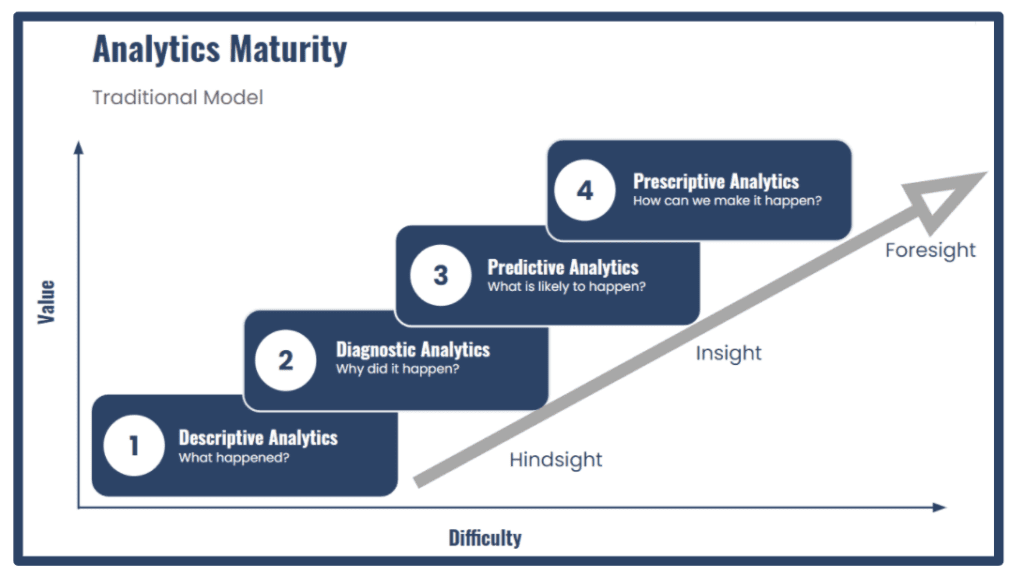
This ridiculous divide kept advanced analysis hidden in data science groups while day-to-day business users were left with static reports.
The future BI platform does not draw these distinctions. It offers traditional descriptive analysis in the form of queries, charts and dashboards. It also calls ML models or apply statistical analysis as necessary. And it is all orchestrated and presented by LLMs which find, produce and contextualize these outputs.
Most importantly, it relies on the right technology for the right task. LLMs should not be free to make up a statistical analysis or render a dashboard when there is a pre-existing, trusted asset on the shelf ready to be used. All things in balance.
Perspective
The most exciting aspect of BI’s future is our ability to offer perspective to data consumers. This means moving beyond presenting numbers to generating narratives that tie past performance, current metrics and future plans together in an easily digestible story. Humans are storytellers, and the next generation of BI platforms will meet them there.
For data consumers this will feel like having a team of expert analysts at your side, finding patterns, adding context and tying data to your goals. These findings will exist in context, in the narrative of your personal or business goals, with projections of what happens next and advice on how to react.
For those of us building these systems, they will throw off incredible new data streams of the questions and intent of our consumers. Data teams struggle to understand what customers want in part because they struggle to tell us, and in part because we simply have no good alternatives to figure it out.
Imagine asking, ‘How have the questions my users asked changed in the last week, and what does that tell me about shifts in their business strategy’ and getting an answer back!
The real breakthrough is BI that teaches data teams what consumers care about, not just what they are able to articulate.
What’s the timeline
It’s Summer 1994, and I’m parked in front of a CRT monitor riding a wave of dial up into the irc room where I roleplay Wheel of Time with people spread across the globe. Tech gurus widely predict that the internet will rapidly change everything; jump forward five years and the world fels mostly the same. 25 years later, it has transformed daily life.
The same will be true for BI. In the next five years, we’ll see real progress: better chat interfaces, stronger ML integrations, easier ways to combine structured and unstructured data. But the core experience may still look familiar.
In twenty five years, it won’t. The BI front end will be unrecognizable, and the role of the analyst will shift from building dashboards to guiding intelligent systems, shaping narratives, and steering decisions.
That’s the future worth preparing for.
This is a really excellent bit of writing. Mostly agree on the sentiment as well - and it your prediction is true, does that mean the future of BI as a profession might be more a mix and analytics engineering and raw skills in being about prompt effectively? Curious to know your thoughts.
At Babbage insight we’re building step 4 of your alerting hierarchy - we monitor your metrics, anticipate any questions you may have, and give you in depth insights on what happened and why.
Prescriptive is a small extension of this coming shortly!